What is 222?
222 is one of the seven games in Poker Flips, our iPhone card game. You're dealt six cards and you split them into three Texas Hold'em hands of two. Then you throw two of those hands away, one at a time, and whatever survives plays the river.
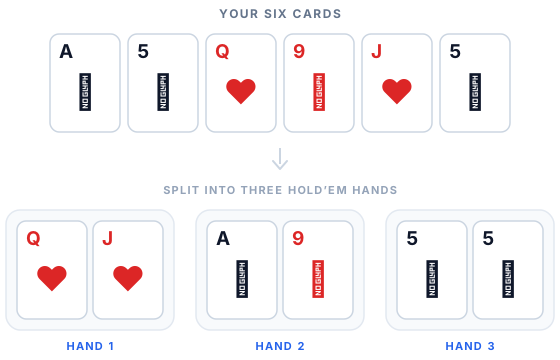
The deal isn't the game. Picking which hand to keep is, and the reason that's hard is timing: both discards happen before the next community card is dealt. You cut to two hands before the turn, then cut to one before the river.
Six cards each, set as three Texas hands of two. See the flop, cut one hand. See the turn, cut another. The last hand plays the river, and the best five cards win.
What you need
- One standard 52-card deck
- Two or more players
- Six cards each to start
How to play, step by step
Deal six cards each and set three hands
Everyone gets six cards face down, then splits them into three Texas Hold'em hands of two cards each, face down.
That split is the first real decision of the round. Six cards pair up fifteen different ways, and you're committing to one of those fifteen arrangements before a single community card exists. Two aces sitting together make one strong hand; split across two hands they make two decent ones.
Discard 1 of your 3 hands
The flop comes out, then you discard one of your three hands face down. Everyone does this at the same time, so nobody sees another player's cut before making their own.
Two community cards are still to come, so a hand that's behind on the flop but has ways to improve is worth more here than the same hand would be one step later.
It's OK to sacrifice a medium pair for a strong suited-connector, especially when you also hold an over pair.
The turn lands
A fourth community card. Two hands left, and one card still to come after this one.
Discard 1 of your 2 remaining hands
Discard one of your two remaining hands, again face down and at the same time as everyone else. Whatever's left is what you're playing.
This cut is the one that decides most rounds, and it runs on different math than the first. Only the river is left, so a draw has exactly one card to hit. The section below works through what that costs.
The surviving hands turn face up
Once every player is down to one hand, the survivors flip face up. From here everyone can see what everyone else kept, which is usually the moment somebody realizes they cut the wrong one.
The river lands
The fifth and final community card. No more discards: the hands are locked.
Showdown
Best five-card hand wins, made from your two hole cards plus three of the five community cards. Standard Texas Hold'em rankings, standard Texas Hold'em evaluation, so the board can play if it beats what everyone's holding.
The round scores
The winner takes one point on the session ledger, which carries across every hand of the night.
The second cut is where rounds are lost
Both discards ask the same question and get different answers, because the number of cards still to come changes between them.
Take a concrete round. You set three hands: Q♥ J♥, A♣ 9♦ and 5♠ 5♣. The flop comes 10♥ 3♥ A♦.
The first cut is easy. Your fives are under both the ace and the ten with two cards to come, so they go. You keep the queen-jack of hearts, which has four hearts working and needs a king for the ace-high straight, and you keep ace-nine, which has already made top pair.
Then the turn comes 6♣, and the board reads 10♥ 3♥ A♦ 6♣. Now the second cut, and it's the interesting one. Queen-jack still has twelve clean cards that make it: nine hearts for the flush, three more kings for the straight. Twelve out of the forty-four you can't see is a little over a quarter.
A quarter sounds live. It isn't enough. Against a single random opponent hand, played to the river:
| Hand you keep | State after the turn | Equity |
|---|---|---|
| A♣ 9♦ | Pair of aces, made | 86.5% |
| Q♥ J♥ | Flush and straight draw, 12 outs | 54.7% |
Keeping the draw gives away better than thirty points of equity. On the first cut, with two cards to come, that same queen-jack is worth holding onto. One street later it isn't, and nothing about the hand changed except the number of cards left.
That's the whole idea behind the two discards. The first one rewards potential and the second one punishes it.
Mystery cards
Two optional toggles change how the endgame plays. Mystery cards on the turn and on the river each give you a blind one-card swap. Both land after that street’s discard, so by the turn you are down to one hand and the swap always applies to the two cards you are still holding. Both are off by default.
They cut against the strategy above. A swap gives a made hand a way to get worse and a dead hand a way to come back, so the tighter the table plays the discards, the more the mystery toggles hurt.
Where the name comes from
Two, two and two: three Texas Hold'em hands of two cards each. Six cards, split three ways, and the arithmetic is the whole name.

Play 222 in Poker Flips
Pass one phone around the table, or send friends a four-letter code and they join from any browser.

FAQ
How do you win a round of 222?
By having the best five-card hand at showdown, made from the two cards in your surviving hand plus three of the five community cards. Standard Texas Hold'em hand rankings apply. The winner takes one point on the session ledger.
When do you discard in 222?
Twice. The first discard comes after the flop, cutting you from three hands to two. The second comes after the turn, cutting you from two to one. Both discards happen before the next community card is dealt, and all players discard at the same time.
Why is the game called 222?
Because you set three Texas Hold'em hands of two cards each: two, two and two. Six cards in total, split three ways.
Which hand should you keep on the second discard in 222?
Usually the made hand rather than the draw. Only one community card is still to come after the second discard, so a strong draw has a single card to hit. In the worked example above a pair of aces runs at 86.5 percent equity against a random opponent hand while a flush and straight draw with twelve outs runs at 54.7 percent.
How many players can play 222?
Two or more players, each dealt six cards from a single standard 52-card deck. A round uses six cards per player plus five community cards, so one deck covers a big table.
Can I play 222 with a real deck?
Yes. Deal six cards to each player, have everyone set three face-down hands of two, and turn discards face down at the same time so nobody sees another player's choice before making their own. The rules on this page are complete.
More rules: all seven Poker Flips games.