What is Kansas Hold'em?
Short version: you get 6 cards, you split them into three separate poker hands, and all three play off one shared board. One is a Texas Hold'em hand, one is a Crazy Pineapple hand, one is an Omaha hand. At showdown your Texas hand fights everyone else's Texas hand, your Omaha fights their Omaha, and so on. Win two of the three and you win the round.
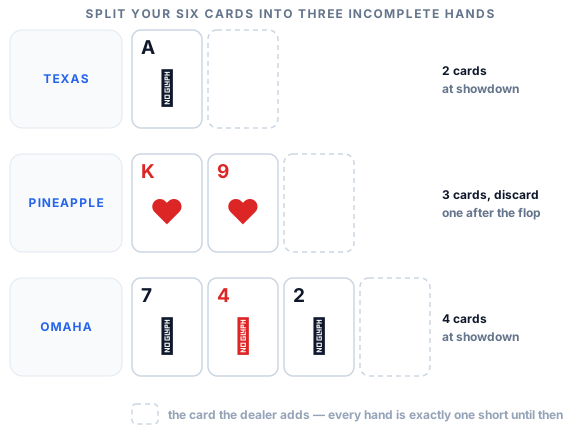
That last part is the whole game. A monster Omaha hand is worth exactly one point, same as a scraped-together pair in Texas. You aren't trying to build one big hand, you're trying to not have a weak spot. It takes about one round to understand and a lot longer than that to be good at.
Six cards each: a 1-card Texas hand, a 2-card Pineapple hand, a 3-card Omaha hand. Discard one from Pineapple after the flop, then turn and river. Best hand in each format takes a point, most points takes the round.
What you need
- One standard 52-card deck, no jokers
- 2 to 4 players, and that cap is arithmetic rather than preference (see below)
- A dealer, rotating clockwise every hand
- Something to keep score on, which is the part the app does for you
Before the hand starts, the dealer calls two settings. First, mystery cards: on after the turn, on after the river, both, or neither. Second, the partial flop: how many community cards everyone gets to see before they set their hands. One is the default and one is correct, but two or three makes it friendlier for a table that's still learning.
Why four players is a hard cap
Kansas Hold'em burns through a deck faster than any normal poker game, because every player is holding three hands at once. Count it out, with both mystery toggles switched on:
| Players | Dealt | Completion | Board | Mystery | Total needed |
|---|---|---|---|---|---|
| 2 | 12 | 6 | 5 | 4 | 27 |
| 3 | 18 | 9 | 5 | 6 | 38 |
| 4 | 24 | 12 | 5 | 8 | 49 |
| 5 | 30 | 15 | 5 | 10 | 60 |
Four players can need 49 of the 52 cards in a single hand, leaving three spare. A fifth player needs 60, and there's no version of a standard deck that has 60 cards in it. That's the whole reason for the cap.
It also explains why the game feels tight at four and roomy at two. At two players you're using barely half the deck, so the same cards come around far less often.
How to play, step by step
Deal six cards each, and show part of the flop
Six cards to every player, face down, plus the first slice of the board. The dealer decides how much of the flop you see before you commit: one card is the default and the hard version, three is how you teach it to somebody on their first night.
Six cards feels generous until you remember you're about to build three hands out of them.
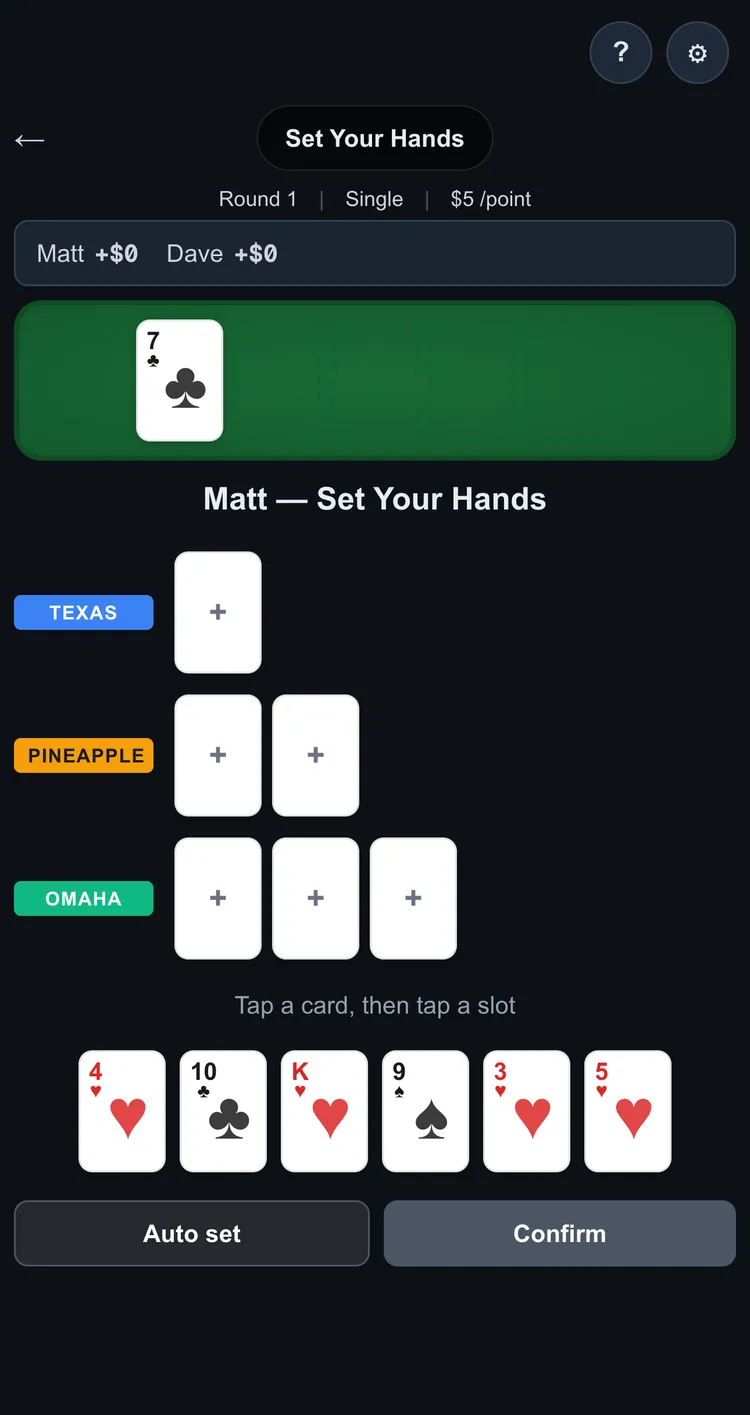
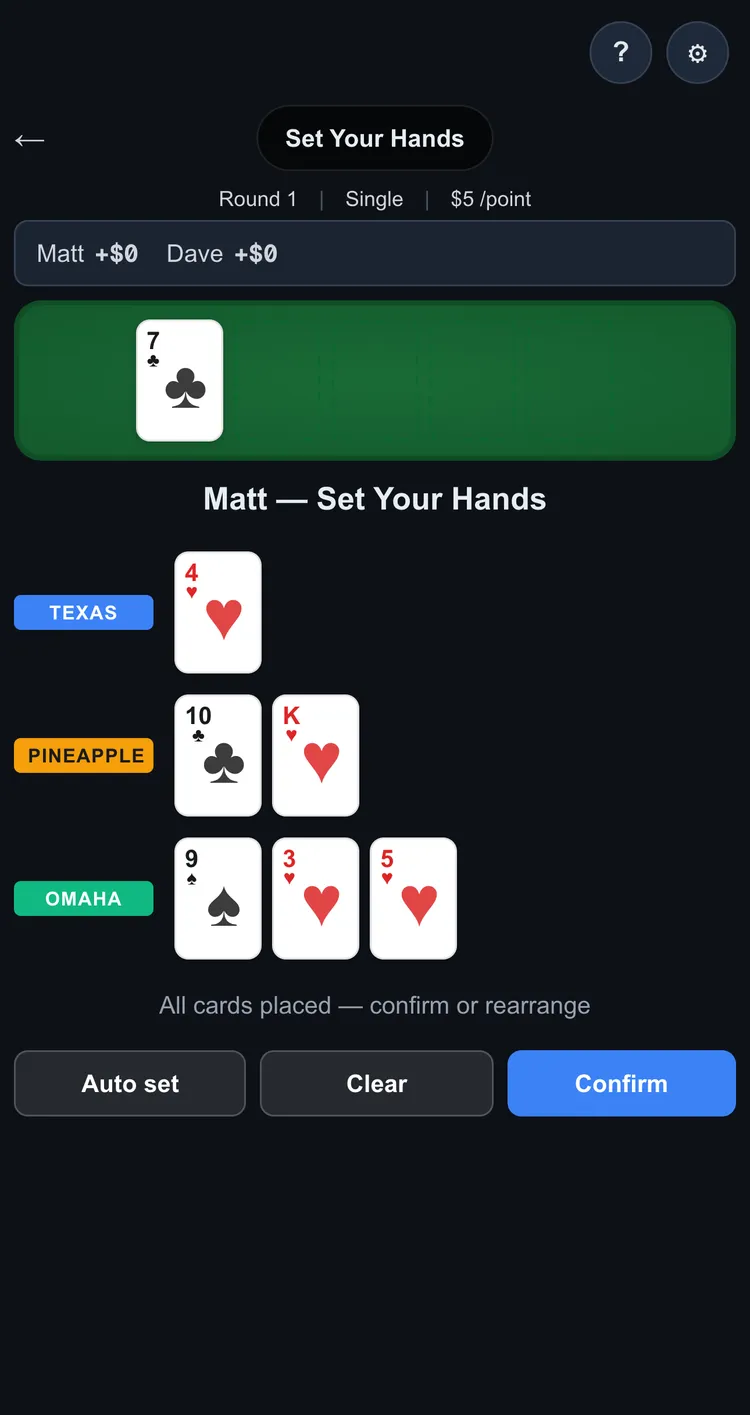
Split your six into three incomplete hands
This is the decision the whole game hangs on. Each hand is short exactly one card: 1 card into Texas, 2 cards into Pineapple, 3 cards into Omaha.
Everything stays face down. The temptation is to load your best three cards into Omaha and build a monster, which quietly hands your opponent the other two points.
The dealer completes the flop and your hands
The rest of the flop comes out so the board is at three cards, then one card lands face down in each of your three hands.
Texas is now 2, Pineapple 3, Omaha 4. This is where the plan from step 2 either looks smart or becomes something you explain for the rest of the night.
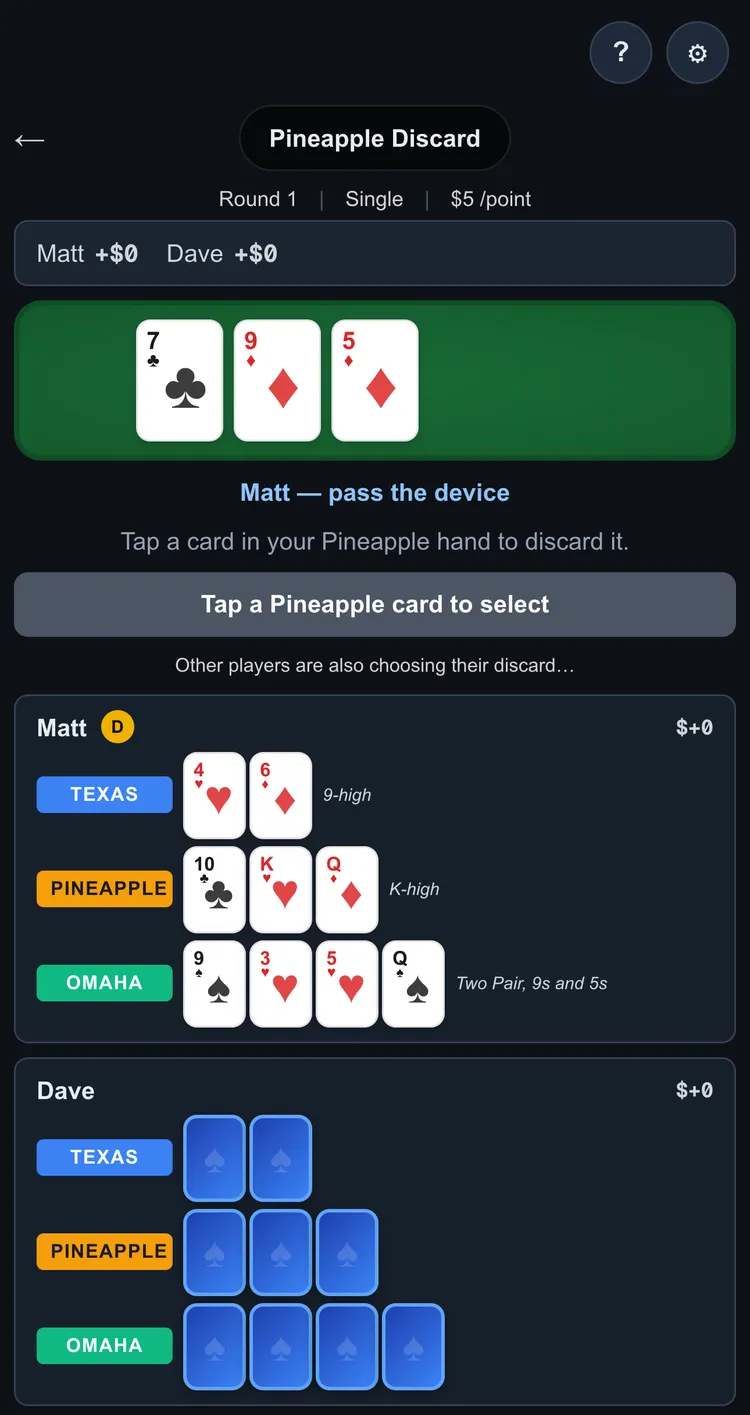
Discard one from Pineapple
Starting left of the dealer. This is Crazy Pineapple, so the discard happens after the flop, which means you actually know something when you make it.
The card is dead. Pineapple is now an ordinary two-card hold'em hand.
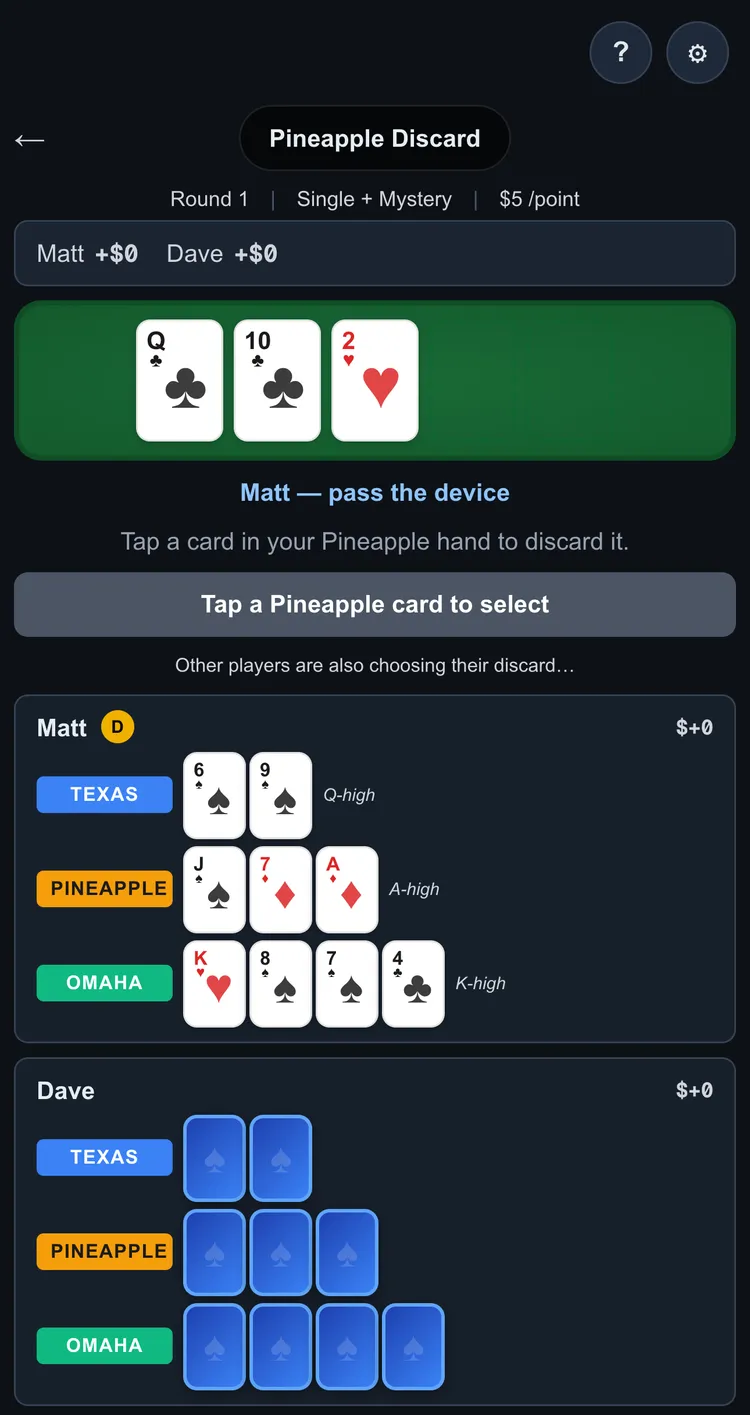
Everyone flips face up
All three hands, all players, everything visible. From here nobody is hiding anything and the rest of the hand plays out with complete information.
If you have never played face-up poker, this is the part that hooks people. You can see exactly what you need and exactly who is beating you.
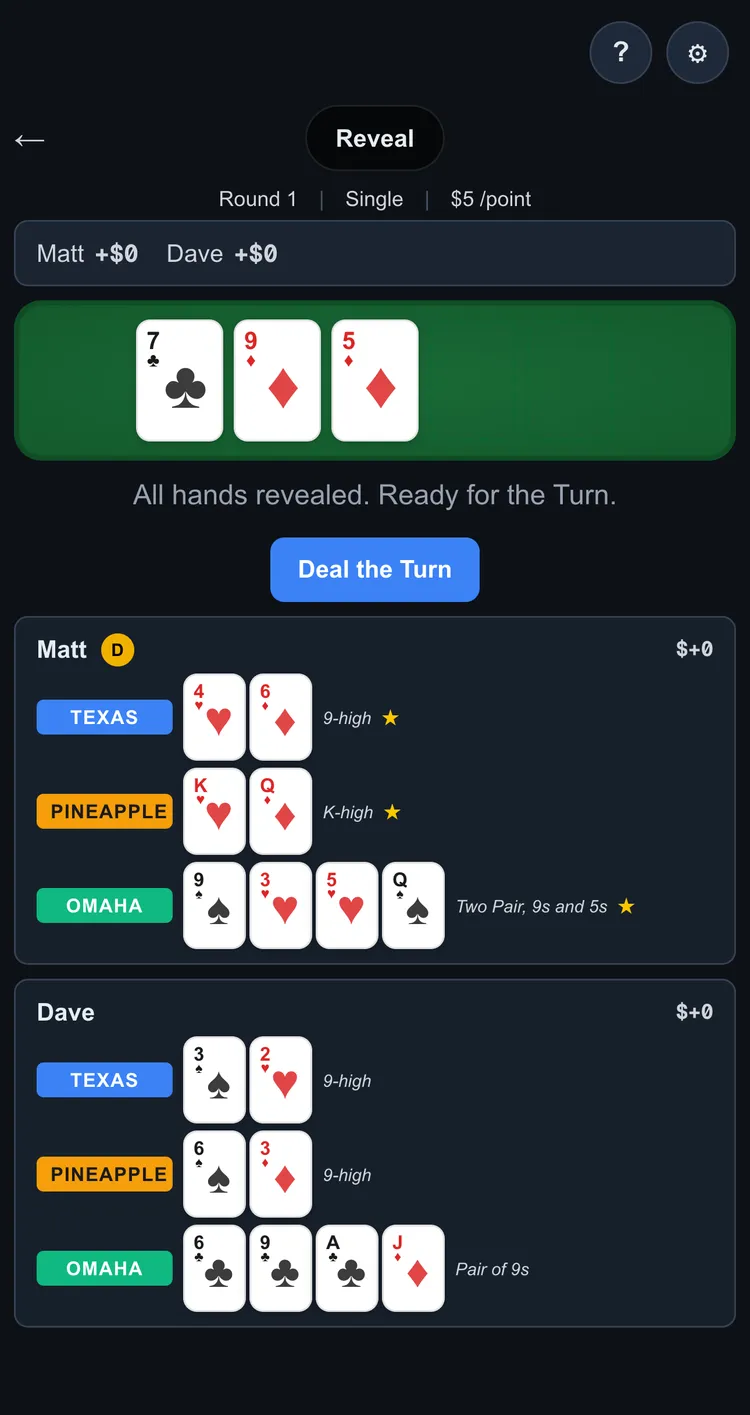
The turn
Fourth community card, shared by all three of your hands at once.
If mystery cards are switched on, this is where each player may swap any one card from any hand for a blind card off the deck. The new card has to stay in the hand it replaced, and everyone's swap stays face down until every player has taken or declined.
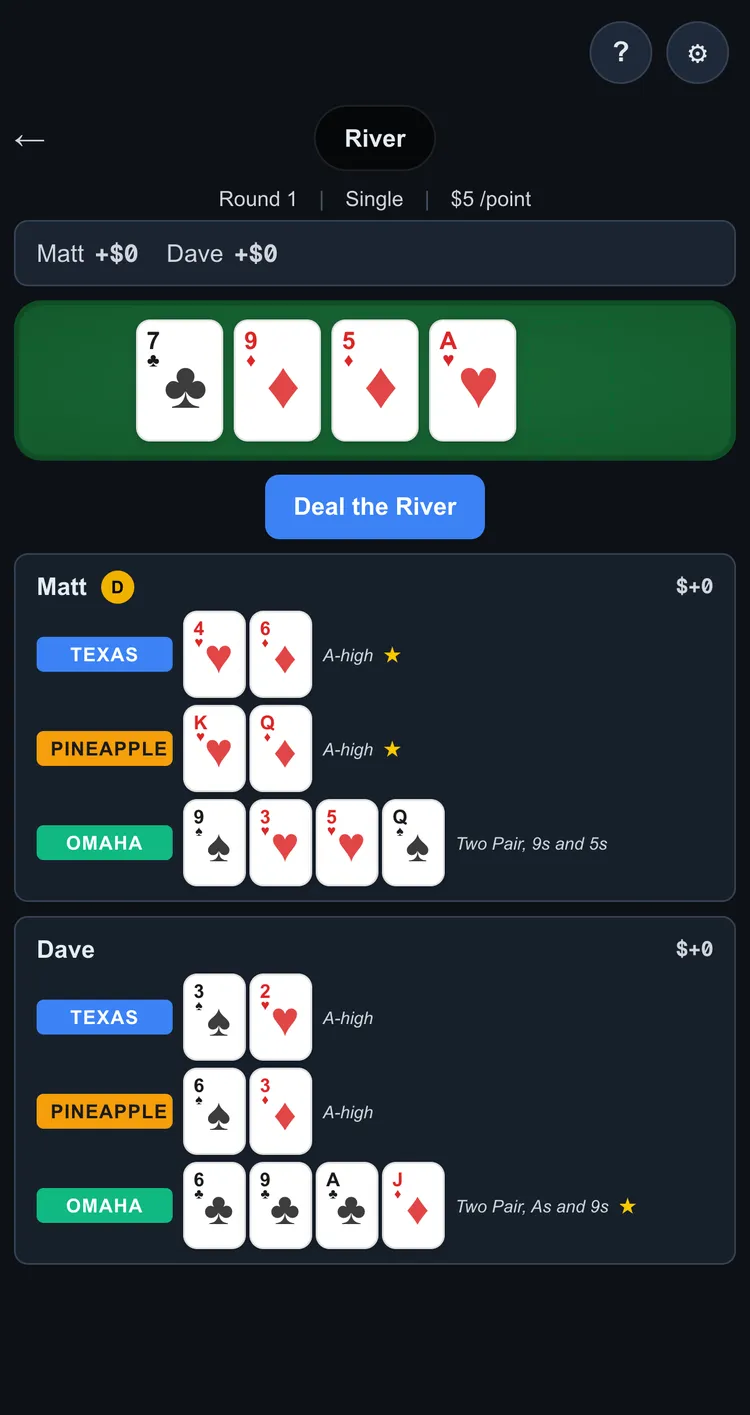
River, then score all three formats
The river completes the board, and every hand is compared head to head against the same format: Texas against Texas, Pineapple against Pineapple, Omaha against Omaha.
Best hand in each format takes a point, ties split half each. Most points wins the round.
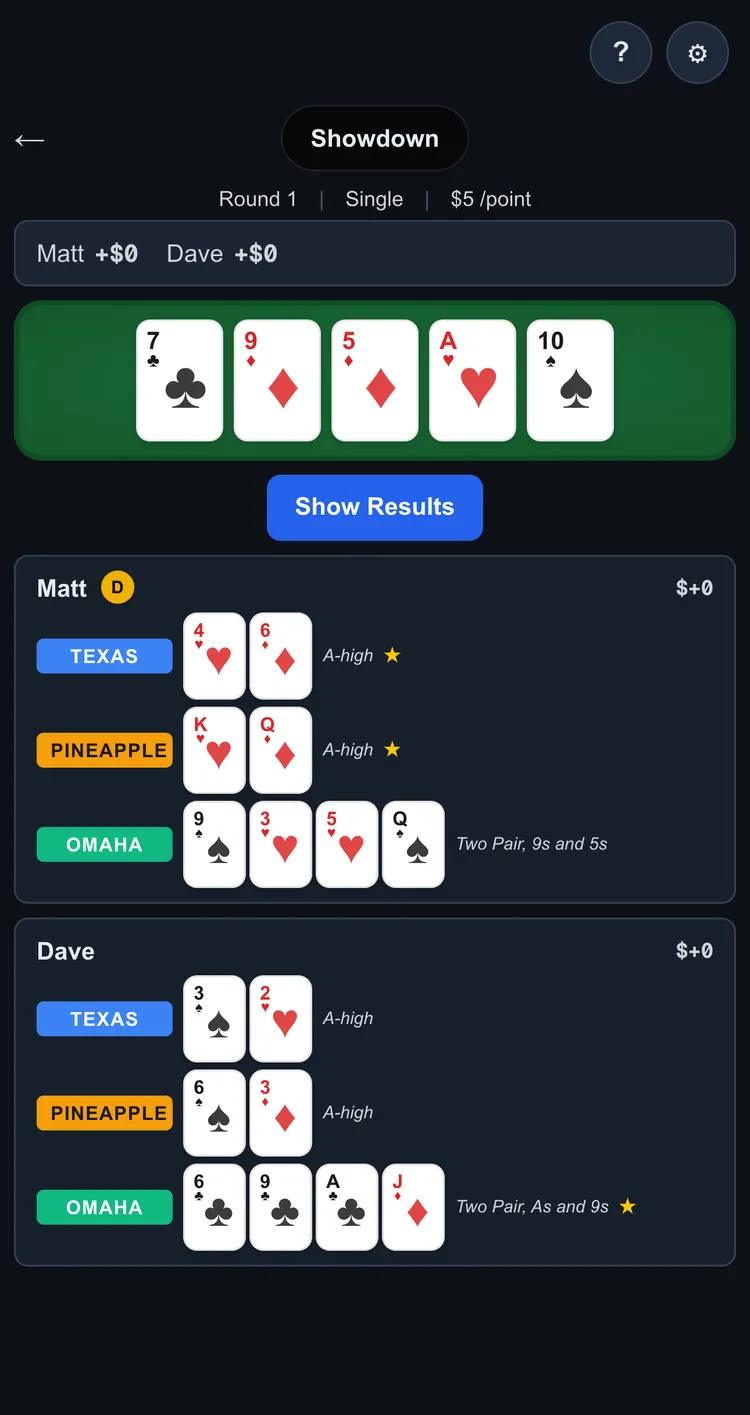
The ledger updates
The round result goes onto the running ledger, which carries across every hand of the session.
This is the paper tally the game was invented around, minus the paper. If variable scoring is on, this is also where each loser draws the card that multiplies the round.
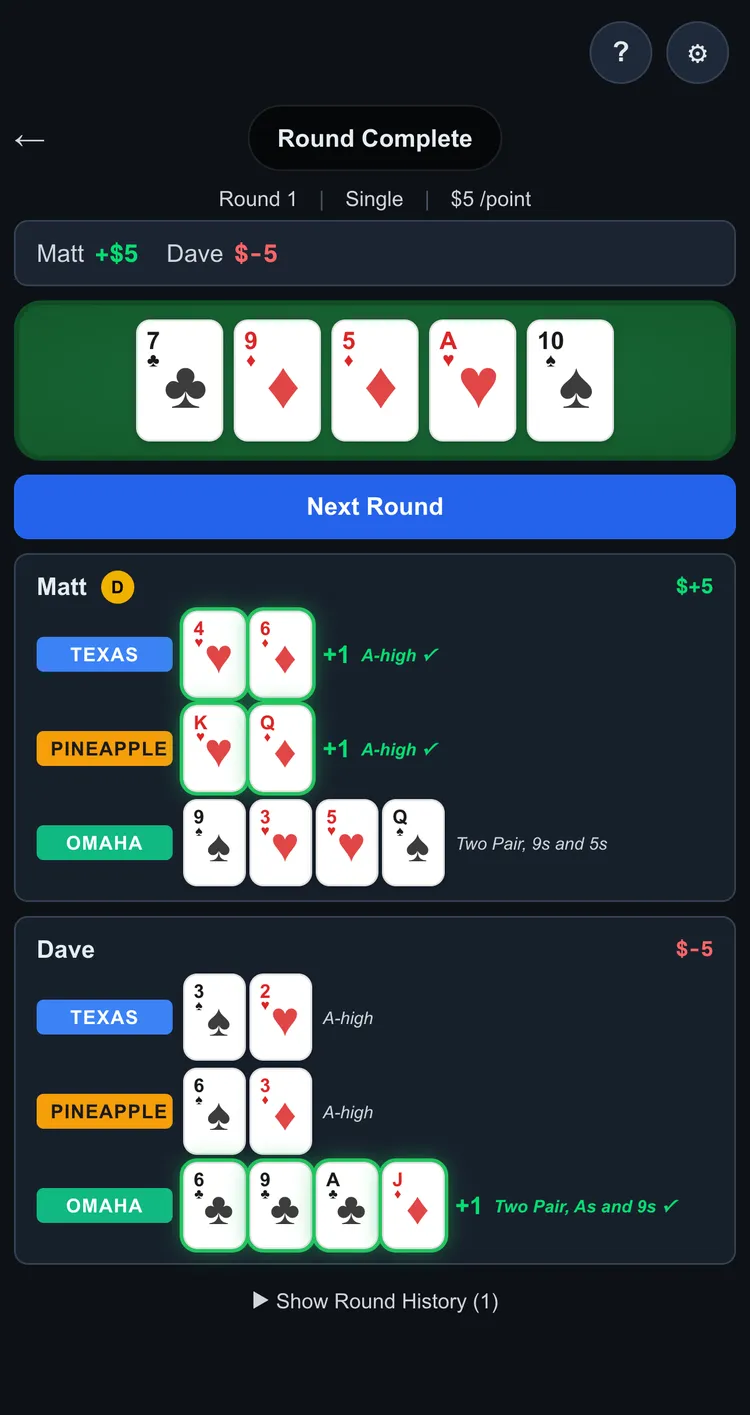
What each hand is at showdown
All three of your hands use the same five community cards. The play rules are the normal ones for each format, which is worth saying out loud because Omaha catches people every time.
| Hand | Hole cards | Board | How it plays |
|---|---|---|---|
| Texas Hold'em | 2 | 5 | Best 5 of the 7, any combination |
| Crazy Pineapple | 2 | 5 | Best 5 of the 7, any combination |
| Omaha | 4 | 5 | Exactly 2 from your hand, exactly 3 from the board |
That Omaha rule isn't optional and it's where new players lose points they thought they had. Four hearts in your hand plus three on the board isn't a flush.
Scoring
Each format is compared head to head across every player. Best Texas hand takes a point. Best Pineapple takes a point. Best Omaha takes a point. Ties split half a point each. Whoever ends up with the most points wins the round.
Winner-take-all per format, not round-robin, and the margin doesn't matter. Winning 3-0 pays the same as winning 2-1. Once that sinks in, the game becomes about coverage rather than power, and people start playing it completely differently.
Ties for the round
Tied players deal a fresh Kansas hand between themselves and settle it. Anyone who wasn't tied sits out the tiebreaker and is still a loser of the original round, which is exactly as annoying as it sounds when you're the one sitting out.
Series mode
Instead of an open-ended ledger, play to a target number of points. First one there takes the round. Half points count toward it.
Additional game features
Kansas Hold'em runs on the same set of toggles as the rest of Poker Flips. Turn them on before the hand and they change how the night plays:
- Variable scoring. The losing players draw a card that multiplies what the round was worth.
- Mystery cards. The optional blind swap described in steps 8 and 9 above.
- Single and Series. One round, or first to a target.
- Partial flop. How much of the board you see before you set your hands.
- Dealer's Choice. Let the dealer pick the game each round, with one ledger across all of it.
Poker Flips never handles money between players. No wagers, no stakes, no real-money play. The ledger tracks who's up and who's down in whatever units your table plays for. What those units mean is your table's business.
Where Kansas Hold'em came from
Finland, 2009. A group of friends who played cards constantly, and mostly played flips: low stakes, usually for drinks. Some nights ran long, some were over in twenty minutes. The point was never the length of the session, it was that nobody had to drag out a chip set. Keep a tally on a piece of paper, settle the drinks tab at the end, done.
The problem with a mixed table is always the same one. The Omaha players want Omaha, the hold'em players want hold'em, and somebody ends up stuck in a game they did not pick.
So we stopped picking. Deal everyone enough cards to play all three at once, score the formats separately, and nobody sits through a game they hate. It worked on the first hand. The rules got sanded down over a lot of nights after that, by the same group, and one of them runs Rakeback.com.
The name is a nod to where I am from, not where it was invented. It stayed a house game for about seventeen years before it became an app, which tells you roughly how fast I finish things.
Three things that took me a while to learn
Your worst hand decides the round, not your best one. Everyone's first instinct is to stack their good cards into Omaha because four cards feels like the strong hand. Then they lose Texas and Pineapple and take one point for a monster. Spread the pain.
The partial flop is worth more than one card should be. One community card before you set is enough to tell you whether you're building toward a suit or a straight, and it's the difference between a plan and a guess. Watch what other players do right after it turns over.
Mystery cards aren't free. A blind swap into a hand you're already winning is how you turn one point into zero. The right time to use one is on the hand you have written off, not the one you're protecting.
FAQ
How many players can play?
Two to four. At four players a single hand can need 49 of the 52 cards, and a fifth player would need 60, so the cap is arithmetic rather than a house preference. The table above shows the count.
Is Kansas Hold'em gambling?
Not in the app. Poker Flips never handles money between players, has no chips to buy and no wagering mechanics. The ledger is a scoreboard.
Do I need the app to play?
No, you can absolutely deal it out with a physical deck using the rules above. The app just means nobody has to remember whose turn it's to discard, or do the multiplier math at 1am.
Can my friends play without downloading anything?
Yes. Start a room, share the four-letter code, and they join from any browser. Only the host needs the app.

Play Kansas Hold'em in Poker Flips
Pass one phone around the table, or start a room and send friends a code.

More rules: all seven Poker Flips games.