What is Open Omaha?
Open Omaha is one of the seven games in Poker Flips, our iPhone card game. It's Omaha Hold'em with every hole card face up: you get four cards, your opponents see all of them, and you see all of theirs. Five community cards come out in the usual order. Best five-card hand wins the round.
You know what beats you, and you know which card would rescue you. New players like that nothing's hidden. Anyone who's played a lot of poker likes that every mistake at the table is on display, including their own.
Four cards each, dealt face up. Flop, turn, river as normal. At showdown, build your best five-card hand from exactly two of your cards and exactly three from the board. Highest hand takes the round.
What you need
- One standard 52-card deck
- Two to four players
- A dealer, rotating clockwise each hand
- A way to keep score, which the Poker Flips app handles
How to play, step by step
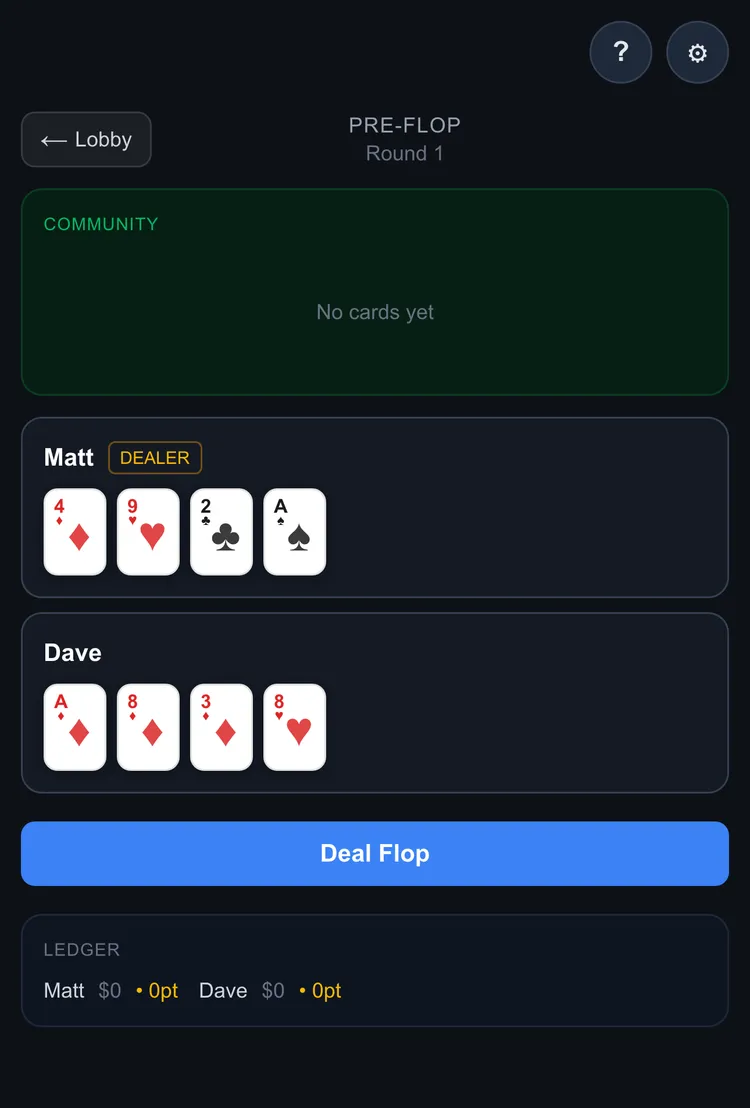
Deal four cards to each player, face up
The dealer gives everyone four hole cards, one at a time around the table, and every card lands face up. Nobody's got private information at any point in the hand.
Look at what your opponents hold before the board arrives. You already know whether you're ahead.
Deal the flop
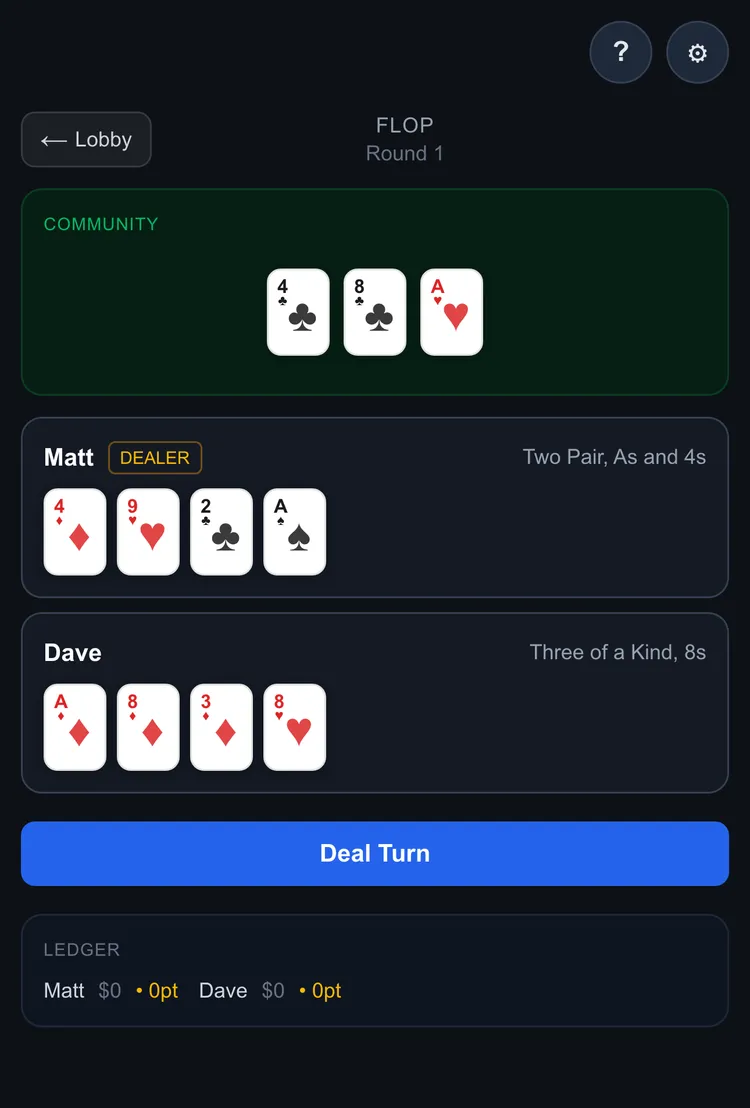
Three community cards land in the middle. Everyone shares them.
The app reads every hand against the board as it changes, so you can see who leads right now and what each player needs.
Open Omaha is a great way to quickly decide who pays for lunch. One hand takes about thirty seconds.
Deal the turn
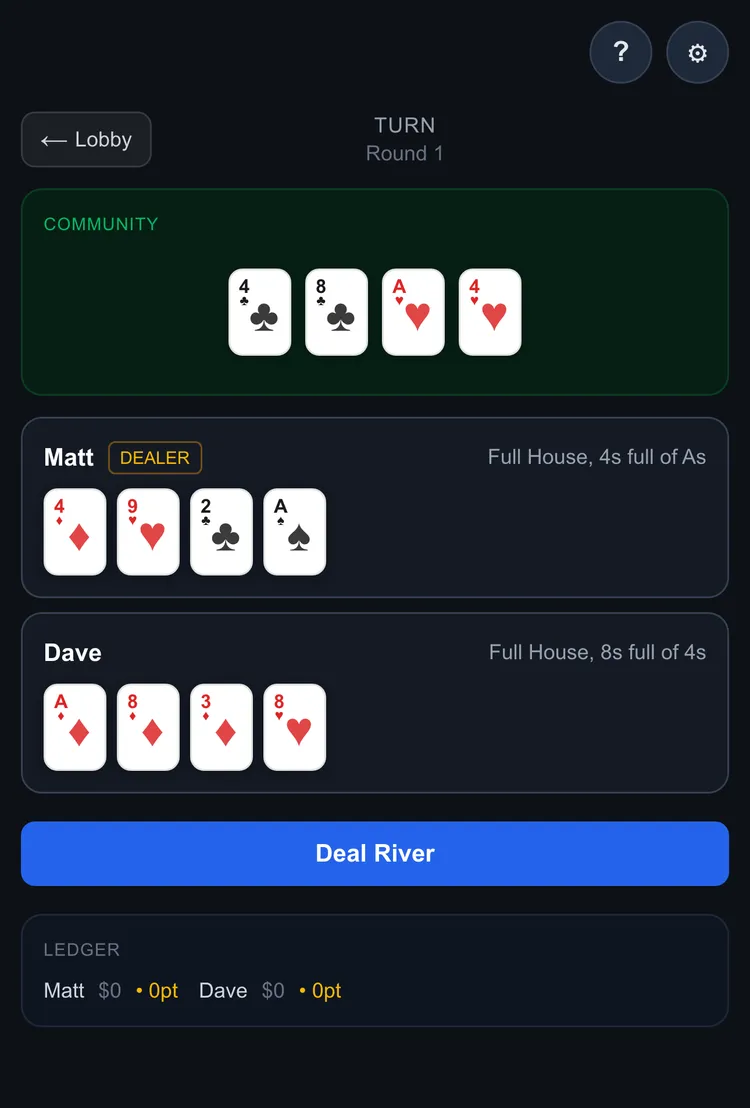
A fourth community card joins the board.
Switch mystery cards on and this is where each player may trade one hole card for a blind card off the deck. Leave it off and the turn just arrives.
Deal the river
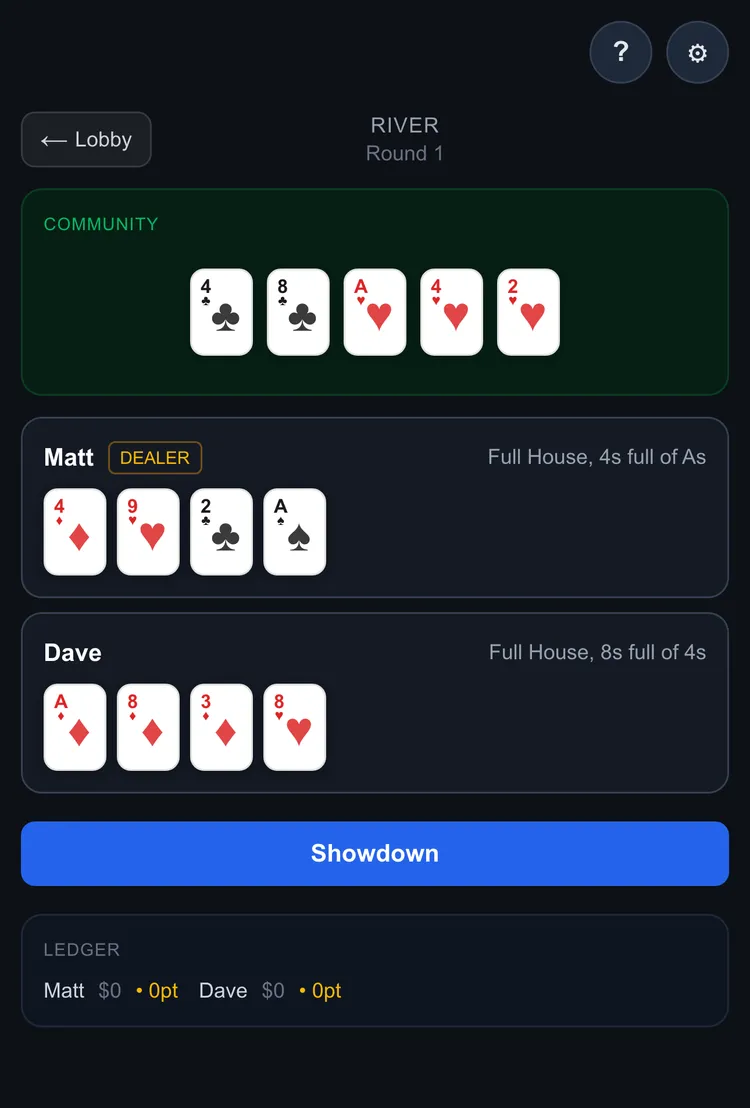
The fifth and final community card completes the board.
Every card in the game is now visible: four in each player's hand and five in the middle. Nothing's hidden and nothing's left to come.
Score the showdown
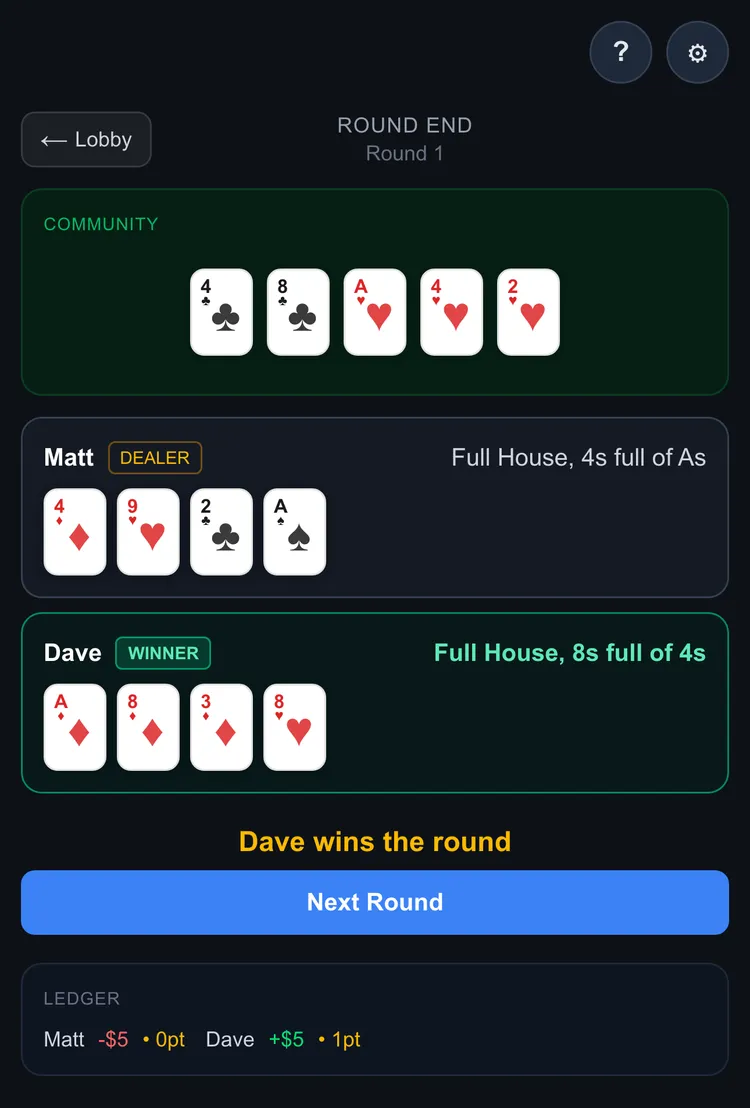
Each player makes their best five-card hand using exactly two hole cards and exactly three community cards. Best hand wins the round and takes a point on the ledger.
That two-and-three rule decides more hands than anything else in this game. The next section shows why.
The rule that decides most hands
Omaha gives you four cards and then limits you to two of them. Take exactly two from your hand and exactly three from the board, every single hand.
Players who come from Texas Hold'em break this rule constantly, because in Hold'em you use any combination of your two cards and the five on the table. Omaha doesn't work that way, and the difference costs people pots for years.
Here's the trap, and it catches everybody at least once.
| Cards | |
|---|---|
| Your hand | A♥ Q♥ J♥ 3♥ |
| The board | K♥ 9♥ 4♠ 2♣ 7♦ |
Four hearts in your hand, two more on the board. Six hearts in play, and it looks like the nut flush.
You haven't got a flush. You have ace high.
Count it through. You take exactly two hearts from your hand, and the board offers only two more. That gives you four hearts in a five-card hand, one short. Your best legal hand is A♥ Q♥ from your cards plus K♥ 9♥ 7♦ from the board: ace, king, queen, nine, seven, no pair, no flush.
Give the board a third heart and the same hand becomes the nut flush. That single card is the whole difference.
Switching your thinking over from Texas Hold'em
In Hold'em you look at your two cards and ask what the board does for them. Here you've got to flip it around and look at the board first, asking what it can give you.
A flush needs three of your suit already out there. A full house needs the board to bring a pair or better. If the board can't hand you three cards toward the hand you're after, you haven't got it, however good your four cards look.
Open Omaha is the best place to learn this, because every hand is visible. You can run the rule against your opponent's four cards as well as your own. Check both for a few rounds and you'll start spotting it without doing the math.
Scoring
Winning the round earns one point on the session ledger. The ledger runs across every hand you play, so the night stays a single contest.
Pick Single to play one round, or Series to play until someone reaches a target you set at the start. Switch on variable scoring and every loser draws a card that multiplies what the round was worth.
Toggles that change the game
The dealer calls these before dealing.
- Five-card Omaha. Deal five hole cards instead of four. You still use exactly two at showdown, so the extra card widens your options without changing the rule.
- Same Color Bonus. If your starting cards come out all red or all black, the dealer keeps dealing you extra cards until the streak breaks. Every extra counts as a hole card. A long streak leaves you with a strange hand and more options than anyone else at the table.
- Mystery cards. One blind swap after the turn, after the river, or both. In a face-up game the swap is public the moment it resolves, so everybody watches the same card arrive.
- Single and Series. One round, or first to a target.
See all Poker Flips features for how each one works across the other games.
Where Open Omaha came from
We didn't invent this one. Face-up Omaha has been a home-game staple for decades, and Omaha itself has been around a lot longer than that.
What we built is the implementation: hands read live against the board, the two-and-three rule enforced so nobody miscounts a flush, and one ledger across the session. Four of the seven games in Poker Flips are ours, and Kansas Hold'em is the one with the story. This isn't one of them, and saying otherwise would be daft.
FAQ
How many players can play?
Two to four.
Can I use three of my hole cards?
No. Exactly two, every time, in every Omaha hand. The app enforces it, so a hand you think is a flush will score as what it actually is.
Do my friends need the app?
No. You start a room, they get a four-letter code, and they join from any browser on any device. Only the host needs an iPhone.
Does face-up poker still work with two players?
Yes, and heads-up is where it sharpens fastest. With one opponent you can read the whole game every hand, so wins and losses come down to who understood the board.

Play Open Omaha in Poker Flips
Pass one phone around the table, or send friends a four-letter code and they join from any browser.

More rules: Kansas Hold'em · Triple Draw · all Poker Flips games