What is Patong Poker?
Patong Poker is brand new. It was invented in 2026 in Patong, Phuket, and it ships in Poker Flips, our iPhone card game. It isn't played anywhere else, and this page is the only written record of the rules we know of.
We've been inventing card games since 2009. Kansas Hold'em is the one people know about, and this is the first since then I'd put next to it.
It starts from Texas Hold'em, then throws out the part every Hold'em player takes for granted: the single showdown at the river. Each street gets scored on its own instead. Win a street and that's a point. Tie one and you take half a point each. First to two points wins the round.
Eight cards each. On every street you play one or two of them, or fold. Best five-card hand takes the street, a tie splits it. First to two points wins the round.
What you need
- One standard 52-card deck
- Two to four players
- Eight cards each to start, adjustable anywhere from six to ten
- A way to keep score, which the Poker Flips app handles
How to play, step by step
The screenshots below follow one real round between two players, from the deal to the ledger.
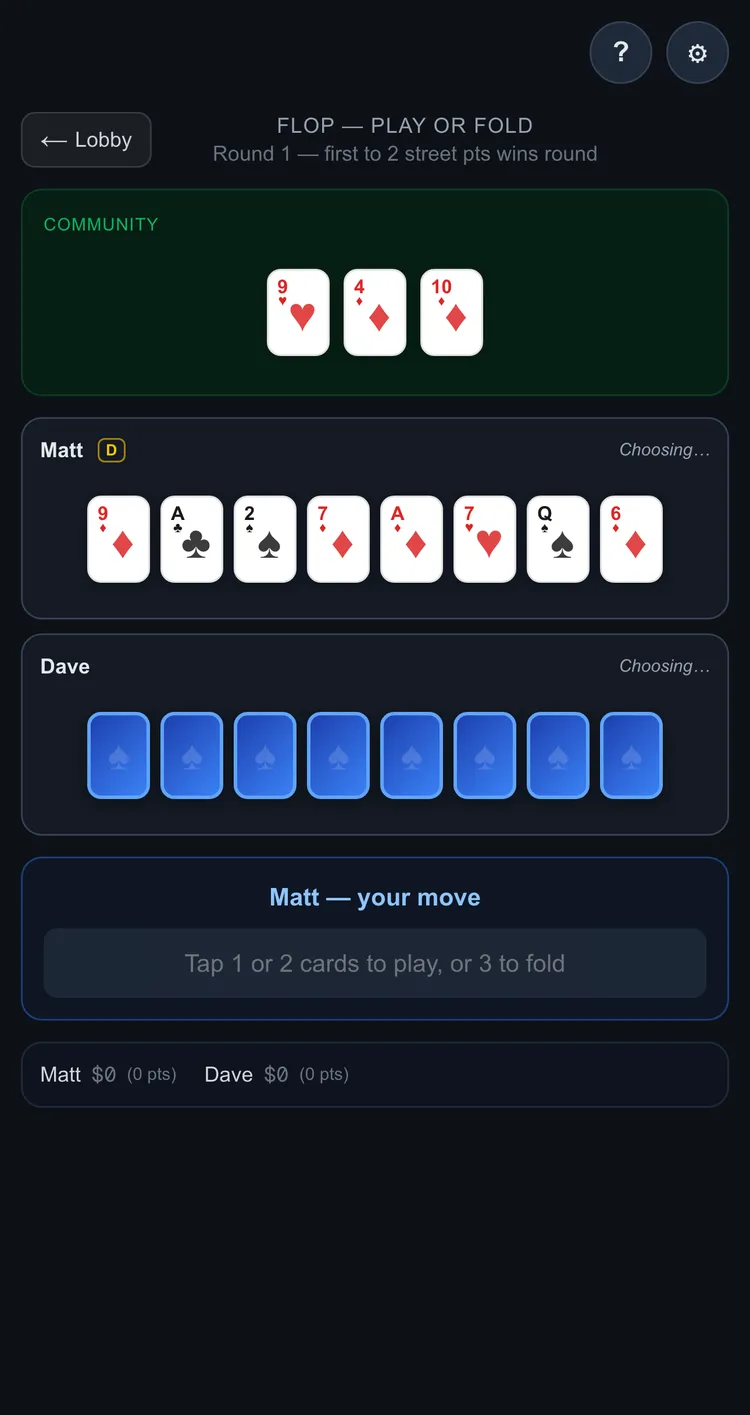
Deal eight cards each, then the flop
Everyone gets eight cards face down. Three community cards come out, and the flop street opens.
Both players now choose at the same time: tap one or two cards to play, or three cards to fold. Nobody acts first, so there's no dealer advantage.
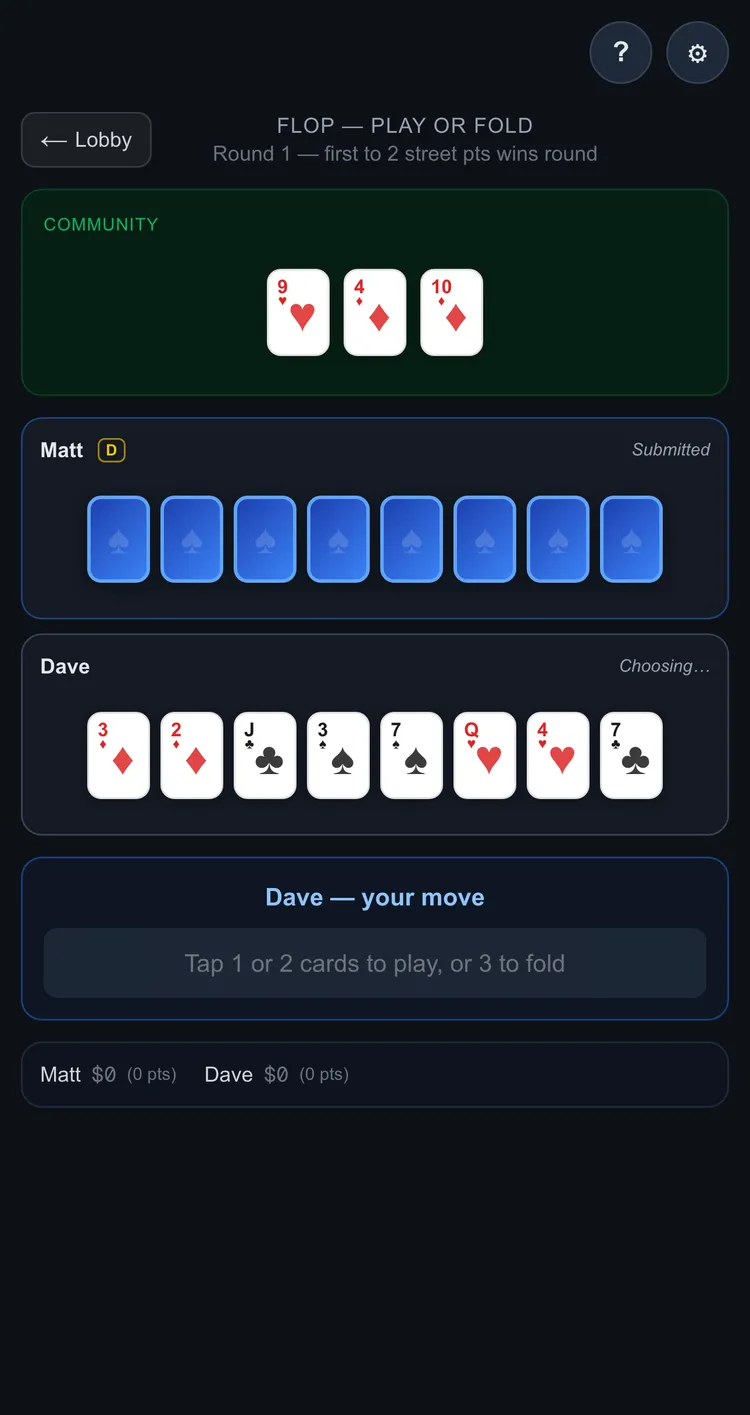
Choices lock in sealed
Once a player commits, the other one sees a neutral Submitted marker and nothing else.
Hiding the fold is the point. If a fold leaked early, the other player would take the street with any card in their hand. The seal holds on a single phone passed around the table too.
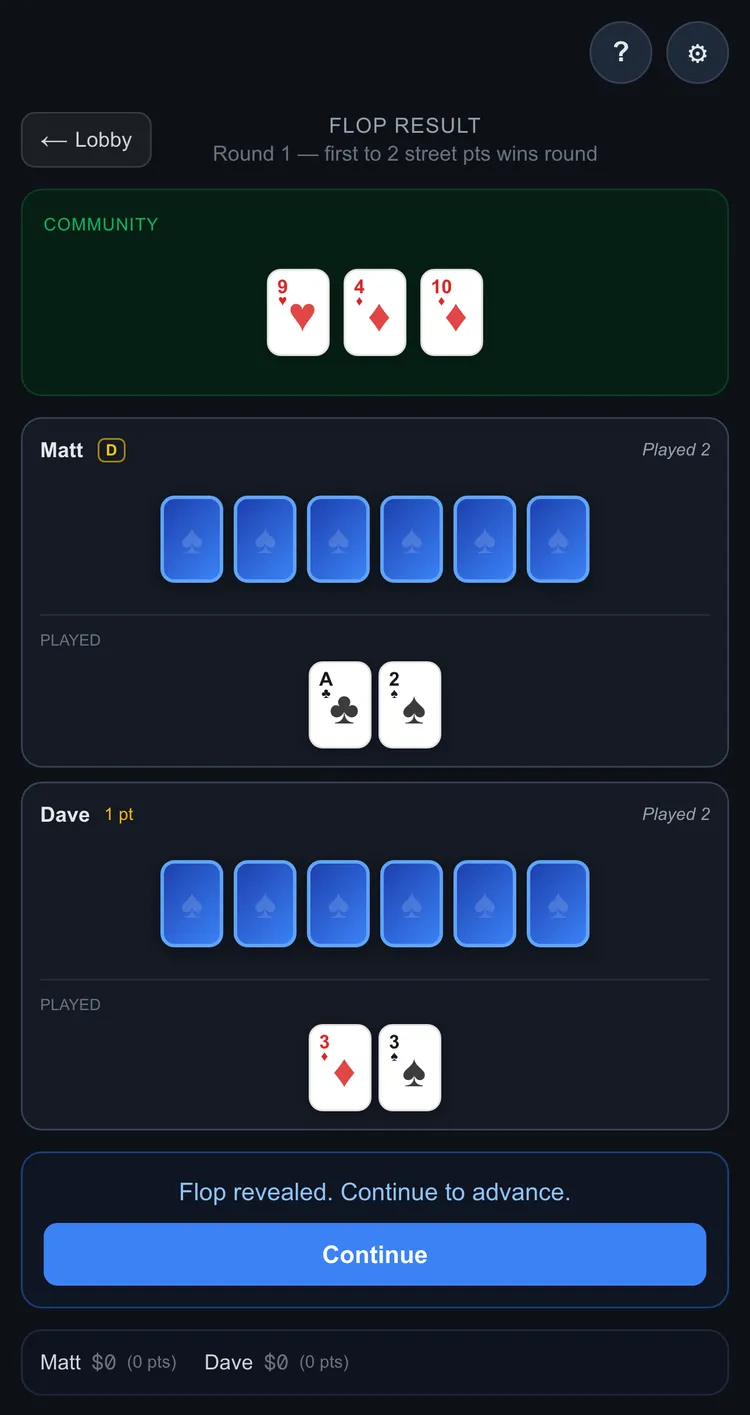
Reveal and score the flop
Both hands turn over at once. Here Matt played A♣ 2♠ for ace high. Dave played 3♦ 3♠ and made a pair of threes on a 9-4-10 board.
A pair of threes takes it. Two cards against three board cards makes for thin hands, so small pairs win real points. Dave leads 1-0.
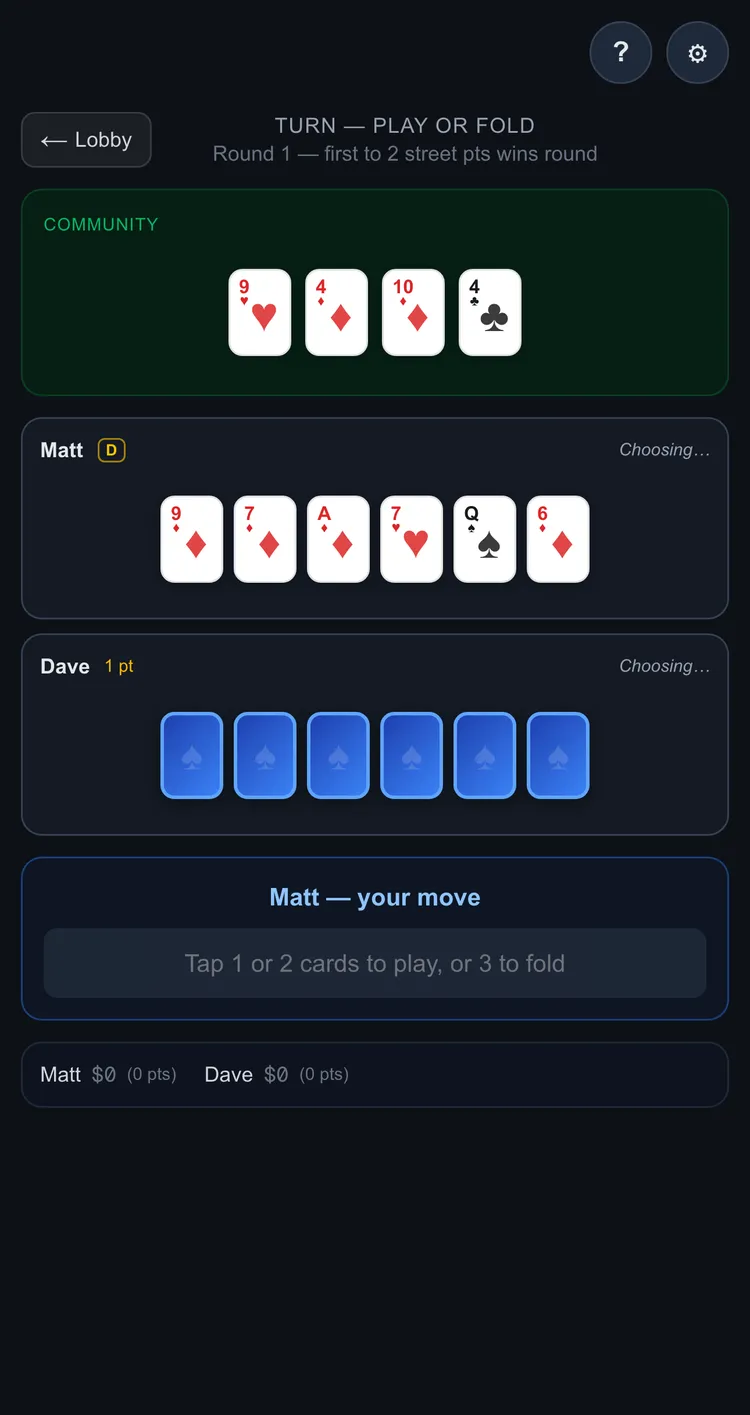
The turn lands and you choose again
The 4♣ joins the board. Both players are down to six cards, since playing two cost them two.
Dave can win the round right here. Matt has to take this street or it's over.
Reveal and score the turn
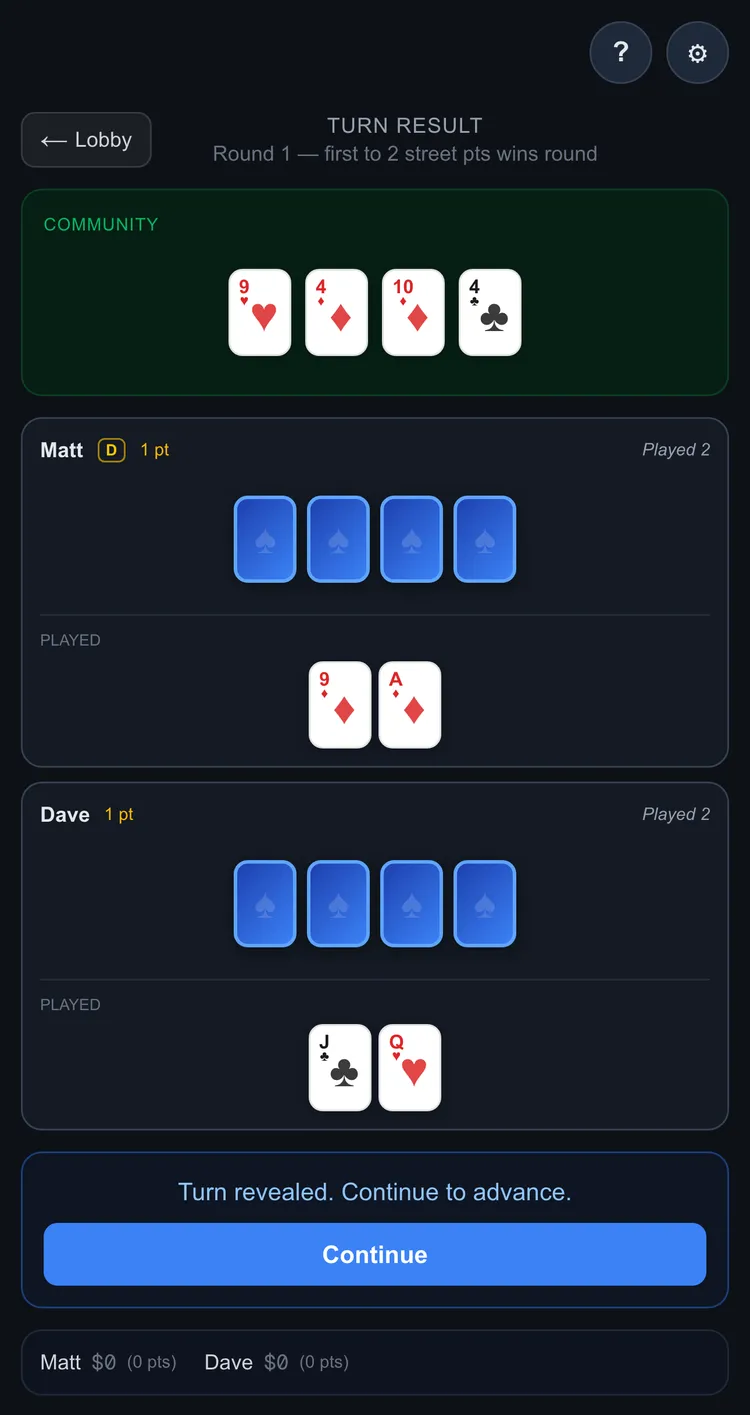
Matt played 9♦ A♦, which pairs the nine on the board alongside the board's own pair of fours. Two pair, nines and fours, ace kicker.
Dave played J♣ Q♥ and got nothing but the board's fours. Matt takes the street, and the round is level at 1-1.
The river decides it
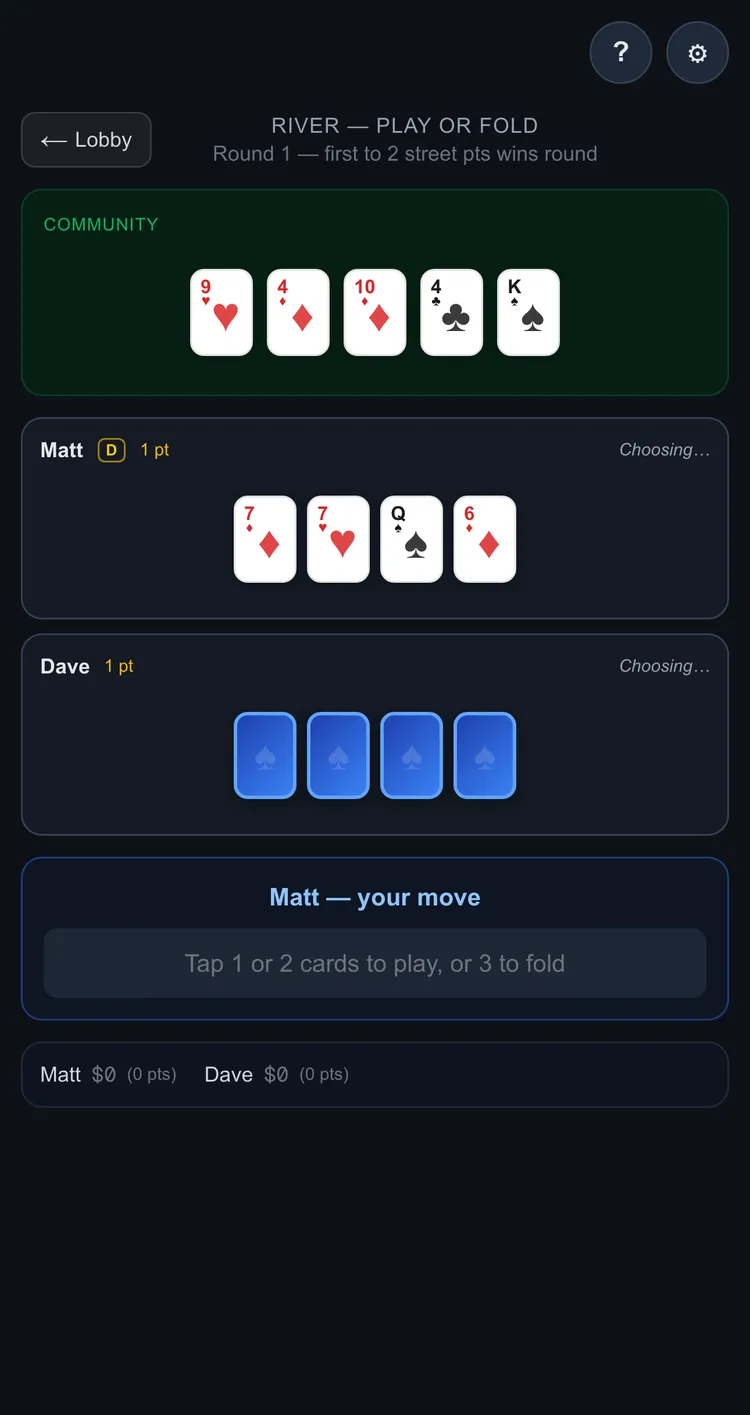
The K♠ completes the board. Four cards left in each hand, one street left, and both players are on a point.
Reveal and score the river
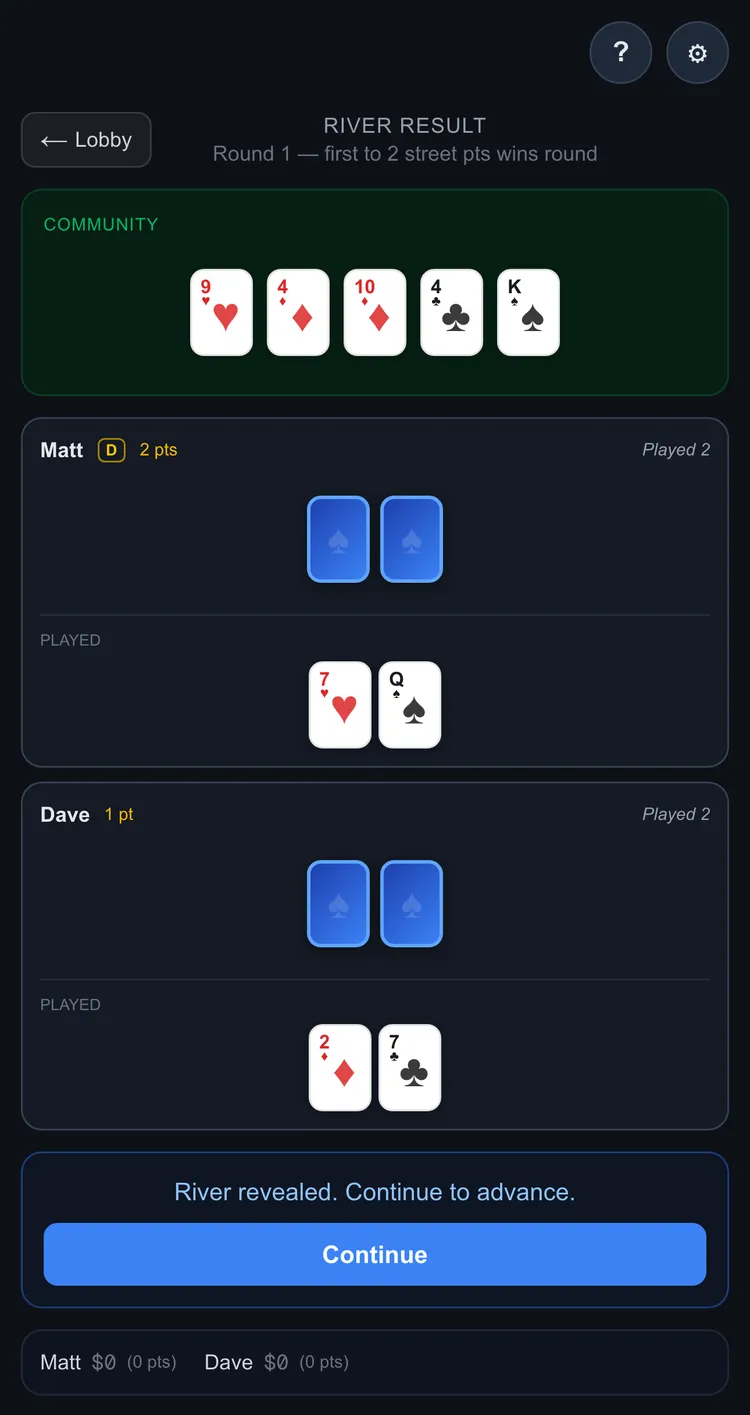
Matt played 7♥ Q♠. Dave played 2♦ 7♣. Neither one improved on the board's pair of fours, so this comes down to kickers, best five cards out of seven.
Matt plays 4♦ 4♣ K♠ Q♠ 10♦. Dave plays 4♦ 4♣ K♠ 10♦ 9♥. The kings match, then the queen beats the ten. Matt takes the river by a single kicker.
If nobody has two points, play the tiebreak
Our example round finished on the river, but plenty don't, and the reason is the half point. Two cards each against a five-card board makes for thin hands, so two players landing on exactly the same hand is common, and a tied street pays half a point to each of them rather than nothing.
It's a flat half, however many tie. Three players level on a street take half a point each, not a third each, and anyone not in the tie takes nothing.
Halves stack up into rounds that finish level:
| Flop | Turn | River | Your total | Outcome |
|---|---|---|---|---|
| Win | Win | - | 2 | Round over on the turn |
| Win | Tie | Tie | 2 | Round yours on the river |
| Win | Loss | Tie | 1.5 | Tiebreak |
| Tie | Tie | Tie | 1.5 | Tiebreak |
| Win | Loss | Wash | 1 | Tiebreak |
Exactly two counts, so a win plus two ties ends the round on the river. Anything short of two and everyone still in the round plays one card. It goes onto the finished five-card board, and the best five out of those six takes the round outright.
One card against a complete board is about as stripped-back as poker gets. Nothing left to draw to, nothing to weigh except which of your remaining cards plays best against what's already showing.
There's no folding at the tiebreak. If you still have cards, you play one. A player who's run out of cards sits out the tiebreak automatically, which can happen if they folded twice earlier in the round.
If nobody's card beats the board, the round ends in a tie and no session point is awarded.
Two points takes the round
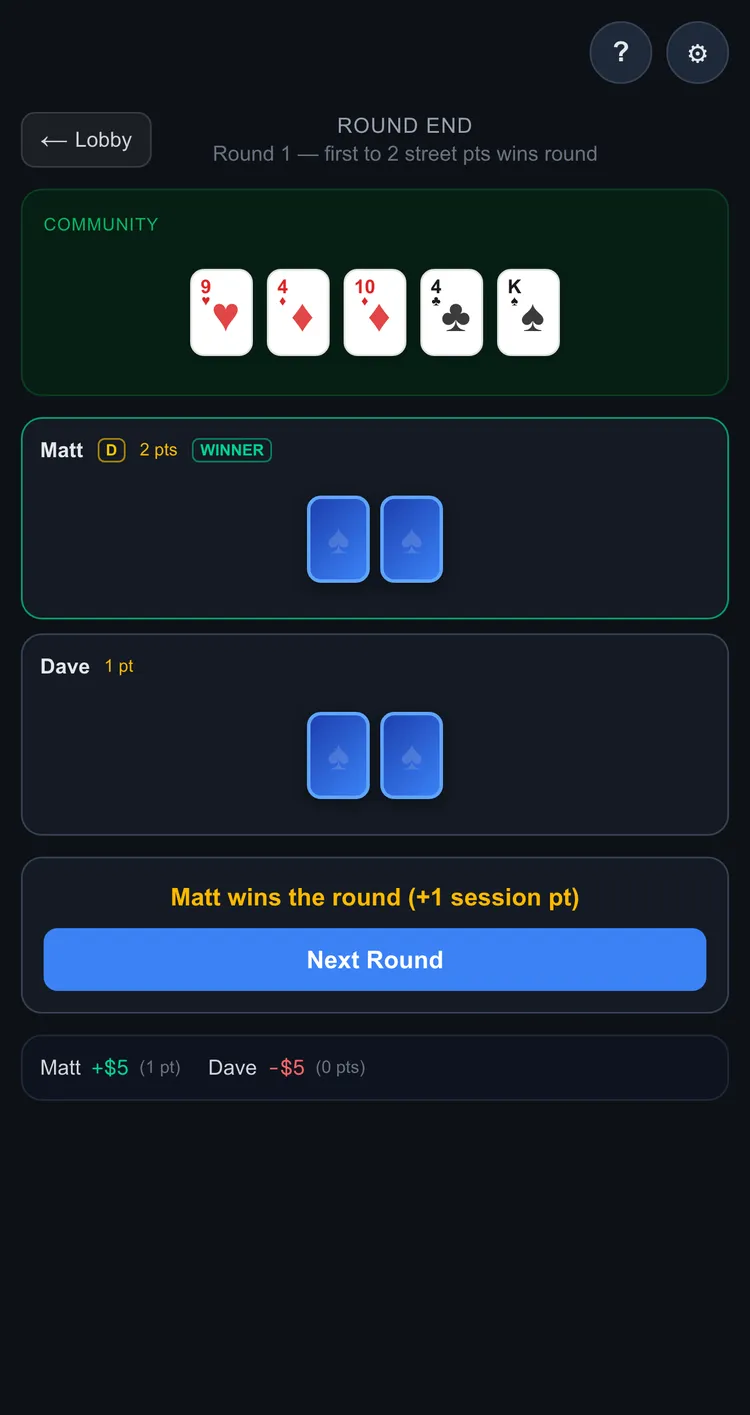
Matt reaches two street points and wins the round, worth one point on the session ledger. Dave finishes on one.
The ledger carries into the next round, so the night stays one long contest.
Play one card or two, and the blank
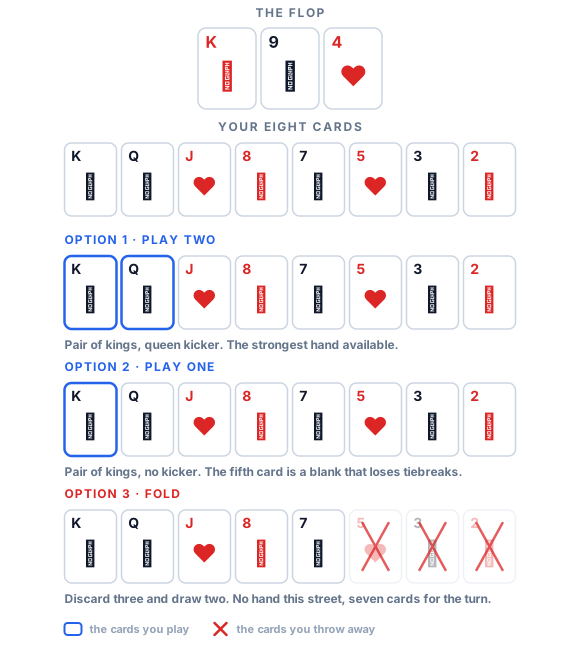
Every street you decide how much to commit. Two cards make the strongest hand you can make right now. One card holds something back for the streets still to come.
On the turn and the river that's a straight trade, because there are four or five board cards out and you've got at least five real cards either way. On the flop it isn't, and this is the rule that catches people.
| Street | Play 1 card | Play 2 cards |
|---|---|---|
| Flop (3 on board) | 4 real cards + 1 blank | 5 real cards |
| Turn (4 on board) | 5 real cards | 6, best five of them |
| River (5 on board) | 6, best five of them | 7, best five of them |
One card plus a three-card flop is four cards, and poker hands are five. The fifth is a blank:
- It never pairs with anything
- It never completes a straight
- It never completes a flush
- It ranks below every real card, so it loses every tiebreaker
So a one-card flop hand can tie on rank and still lose:
| Plays | Five-card hand | Result | |
|---|---|---|---|
| Flop: K♣ 7♦ 2♠ | |||
| Player A | K♥ | K♥ K♣ 7♦ 2♠ blank | Pair of kings, kickers 7, 2, blank |
| Player B | K♦ 6♥ | K♦ 6♥ K♣ 7♦ 2♠ | Pair of kings, kickers 7, 6, 2 |
Same pair, same top kicker. Then B's six beats A's two, and A's blank never gets a say.
On the flop, playing one card costs you a live fifth card and buys you one more card in reserve. On the turn and the river it's free.
Folding is good strategy, sometimes
Folding means discarding three cards and drawing two. You can't win the street, and everything you discarded is gone. It sounds like giving up, and two bits of arithmetic say otherwise.
First, folding costs you fewer cards than playing. Play two and you're down two. Fold and you're down three but back up two, so net one. Fold the flop and you go into the turn with seven cards, two of them fresh off the deck, against an opponent sitting on six.
| Line | After flop | After turn | After river |
|---|---|---|---|
| Play 2 on every street | 6 | 4 | 2 |
| Fold the flop, then play 2 | 7 | 5 | 3 |
Second, you can afford to give away exactly one street. Two points wins the round and there are only three on offer, so one fold still leaves you a live path. A second fold doesn't. Fold the flop and you need both the turn and the river outright, though tying either one drags the round to a tiebreak rather than ending it.
The deck runs out too. From eight cards you can fold at most twice, because 8 minus 3 is 5 and 5 minus 3 is 2, and you can't discard three from two.
Then there's the standoff. If you're confident your opponent is folding this street, any card in your hand wins it, so you'd play the cheapest thing you own. If they're thinking the same about you, you both fold, nobody's eligible, and the street is a wash. This is a brand new game and nobody's solved that one yet.
Folding can also be switched off entirely before the deal, if the table would rather everyone play every street.
Scoring
Winning the round is one point on the session ledger, the same as every other game in Poker Flips. Pick Single for one round, or Series to play until someone hits a target you set at the start.
Switch on variable scoring and the loser of each round draws a card that multiplies what it was worth, anywhere from 1x to 10x.
Where Patong Poker came from
It was invented by the owner of Rakeback.com in 2026, in Patong, Phuket, and went into Poker Flips the same year. That makes it the newest of the seven games in the app by some distance.
If you ever find someone playing it who didn't learn it from us, we'd like to hear about it.
FAQ
How do you win a round?
Get to two points. Winning a street is worth one and tying one is worth half, so winning the flop and the turn ends it before the river is dealt, and so does a win plus two ties.
Can I play one card instead of two?
Yes, on any street. On the flop it leaves you with a blank fifth card that loses every tiebreaker, so it costs you something real there. On the turn and the river it costs you nothing.
What happens if everyone folds the same street?
Nobody's eligible, so the street is a wash and no point is awarded. Play moves on.
What happens if a street is tied?
Every tied player takes half a point, flat, however many of them there are. That's why the tiebreak comes up so often: two halves and a loss leaves you on 1.5, which isn't two.
What happens if the river doesn't settle it?
Everyone still in the round plays one card onto the finished board, and the best five out of six takes it. There's no folding at the tiebreak, and a player who's out of cards is skipped. If nobody beats the board, the round is a tie.
How many players?
Two to four.
Can I play Patong Poker with a real deck?
Yes, and that's how it was invented. Deal eight each, and put your cards down face down at the same time so nobody sees the other choose.

Play Patong Poker in Poker Flips
Pass one phone around the table, or send friends a four-letter code and they join from any browser.

More rules: Kansas Hold'em · Open Omaha · Triple Draw · all Poker Flips games