What is 2 & 3 Omaha Hands?
Two of the seven games in Poker Flips, our iPhone card game, and they're the same game at two sizes. You get one large deal, you split it into Omaha hands of four cards each, and then you throw hands away as the board fills up. Whatever survives plays the river.
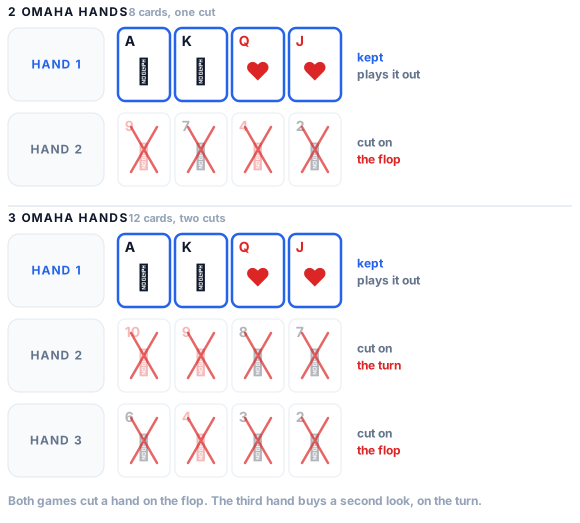
2 Omaha Hands deals you eight cards, which you set as two hands of four. One discard. 3 Omaha Hands deals you twelve, set as three hands of four, and you discard twice.
Hands never play against each other. By showdown you're holding one Omaha hand, the same as everybody else, and the best one at the table takes the round. If you've played 222, this is that game with Omaha hands instead of Texas ones.
Eight or twelve cards, set as Omaha hands of four. Everyone cuts a hand on the flop, and the three-hand game cuts again on the turn. Your last hand turns face up and plays out. Best Omaha hand wins.
What you need
- One standard 52-card deck
- 2 Omaha Hands: two to four players, eight cards each
- 3 Omaha Hands: two to three players, twelve cards each
- A dealer, rotating clockwise each hand
- A way to keep score, which the Poker Flips app handles
How many players can play, and why
The whole round has to come out of one 52-card deck, and twelve cards a player eats through it fast. Here's what a full round costs, with both mystery card toggles switched on:
| Players | 2 Omaha Hands | 3 Omaha Hands |
|---|---|---|
| 2 | 25 | 33 |
| 3 | 35 | 47 |
| 4 | 45 | 61 |
| 5 | 55 | 75 |
Cards needed for one round: the deal, the five community cards, and one mystery swap per player on the turn and one on the river. Anything in red is more cards than a deck has.
So 3 Omaha Hands stops at three players and 2 Omaha Hands at four. The two-hand game would squeeze five in with the mystery cards switched off, but not with them on, so the cap holds either way and a table can flip the toggles mid-round without running out of deck. Kansas Hold'em is capped at four for the same reason.
How to play, step by step
Deal, then set your hands
Eight cards each in the two-hand game, twelve in the three-hand game, all face down. You split them yourself into hands of exactly four, and they stay face down.
This is the decision the whole round hangs on, and it happens before a single community card exists. Eight cards make 35 distinct splits into two hands. Twelve cards make 5,775 into three.
The flop, and the first cut
Three community cards, then everybody discards a hand, face down and at the same time, so nobody sees another player's cut before making their own.
In 2 Omaha Hands that's your only cut. You're down to one hand with two streets still to come. In 3 Omaha Hands you still hold two.
The turn, and the second cut in the three-hand game
A fourth community card. In 3 Omaha Hands you now cut to a single hand of four, face down and simultaneously, with only the river left to come.
In 2 Omaha Hands there's nothing to decide. You've been down to one hand since the flop.
The surviving hands turn face up
As soon as every player is down to a single hand, the survivors flip. That's on the flop in the two-hand game and on the turn in the three-hand game. From there it plays like Open Omaha: everyone can see what everyone kept, and what everyone threw away is gone for good.
Mystery card on the turn, if it's switched on
An optional blind one-card swap on the hand you're still holding. It resolves after the cut and after the hands turn face up, so it always lands on the survivor and never on a hand you were about to throw away.
Because everything is face up by now, the swap is public the moment it happens.
The river
The fifth and final community card. If the river mystery card is switched on, each player gets one more blind swap here. Otherwise the hands are locked.
Showdown
Best five-card hand wins, made from exactly two of your four cards and exactly three from the board. Standard Omaha rules and standard hand rankings. The winner takes one point on the session ledger, which carries across every hand of the night.
The two-and-three rule, and which hand to keep
Omaha gives you four cards and then limits you to two of them. Take exactly two from your hand and exactly three from the board, every single time. That rule is what makes the cut hard, because the hand that looks strongest face down is often the one to cut.
The classic trap is four cards of one suit. Four hearts in a hand of four looks like a flush waiting to happen, and it isn't one. You can only take two of them to the showdown, so the board has to bring three more hearts before you make a flush at all — and a board with three hearts on it means everybody else is drawing to the same flush with better hearts than yours. Open Omaha works through this in full.
The same logic runs the other way. A hand with two suits, two pairs of connected cards and no duplication is worth more than a hand full of aces, because it makes more legal two-card combinations. Four of a kind in your hand is the worst thing you can be dealt: two of the four are dead weight and the other two make one pair. Four deuces is the literal worst hand in Omaha.
How many ways can you split the deal?
Here's how much room you get when you split the deal, compared with the game this one is built on:
| Game | Cards dealt | Hands | Ways to split them |
|---|---|---|---|
| 222 | 6 | 3 of 2 | 15 |
| 2 Omaha Hands | 8 | 2 of 4 | 35 |
| 3 Omaha Hands | 12 | 3 of 4 | 5,775 |
Distinct splits, so holding the same hands in a different order counts once. Picking four of your eight cards can be done 70 ways, but the four you leave behind are the other hand, so that counts every split twice: 70 ÷ 2 = 35. Twelve cards work the same way, one step longer. 495 ways to pick the first hand, 70 for the second, one for what's left, then divided by the six orders three hands can sit in: 495 × 70 ÷ 6 = 5,775.
Nobody works through 5,775 arrangements at the table. What the number means in practice is that there's almost always a better split than the one you just made. Stacking your four best cards into one hand is a decision you're making, even when it doesn't feel like one, and two ordinary hands that both make legal two-card combinations beat one monster and one dead hand.
2 Omaha Hands vs 3 Omaha Hands: what's different
Both games make their first cut on the flop, so the third hand buys you a later decision. In 2 Omaha Hands the flop cut is final: you're locked into four cards, face up, with the turn and the river still to come. In 3 Omaha Hands you carry two hands into the turn and see a fourth community card before choosing.
So a hand that's behind on the flop but has ways to improve is worth carrying in the three-hand game. You get to check whether it improved before committing. In the two-hand game you're committing on the flop either way.
Mystery cards
Two optional toggles, one on the turn and one on the river, each giving a blind one-card swap. Both are off by default and both resolve after that street's discard, so they only ever touch the hand you kept.
They bite harder here than in most of the app. A swap into an Omaha hand replaces one of the four cards you chose to work together, and it can break every two-card combination you set the hand up to make. Use one on the hand you've already written off.
FAQ
How do you win a round of 2 or 3 Omaha Hands?
By having the best five-card hand at showdown, made from exactly two cards in your surviving hand and exactly three from the board. Standard Omaha rules. The winner takes one point on the session ledger.
What is the difference between 2 Omaha Hands and 3 Omaha Hands?
The size of the deal and the number of discards. Two hands means eight cards and a single cut on the flop. Three hands means twelve cards and two cuts, one on the flop and one on the turn. Everything else is identical.
When do you discard in 2 and 3 Omaha Hands?
In the two-hand game, once on the flop. In the three-hand game, once on the flop and again on the turn. Every discard is face down and simultaneous, so nobody sees another player's choice before making their own.
Are the hands face up or face down?
Face down until the last discard. Once every player is down to a single hand of four, those hands turn face up, and they do it before any mystery card is resolved.
How many players can play?
Two to four for 2 Omaha Hands, two to three for 3 Omaha Hands. Both caps come out of the deck: twelve cards a player plus the board plus mystery cards runs a four-handed game past 52.
Can I play with a real deck?
Yes. Deal eight or twelve cards to each player, have everyone set their hands face down, and turn discards face down at the same time so nobody sees another player's choice. The rules on this page are complete.

Play 2 and 3 Omaha Hands in Poker Flips
Pass one phone around the table, or send friends a four-letter code and they join from any browser.

More rules: 222 · Open Omaha · Kansas Hold'em · Patong Poker · Triple Draw · all Poker Flips games